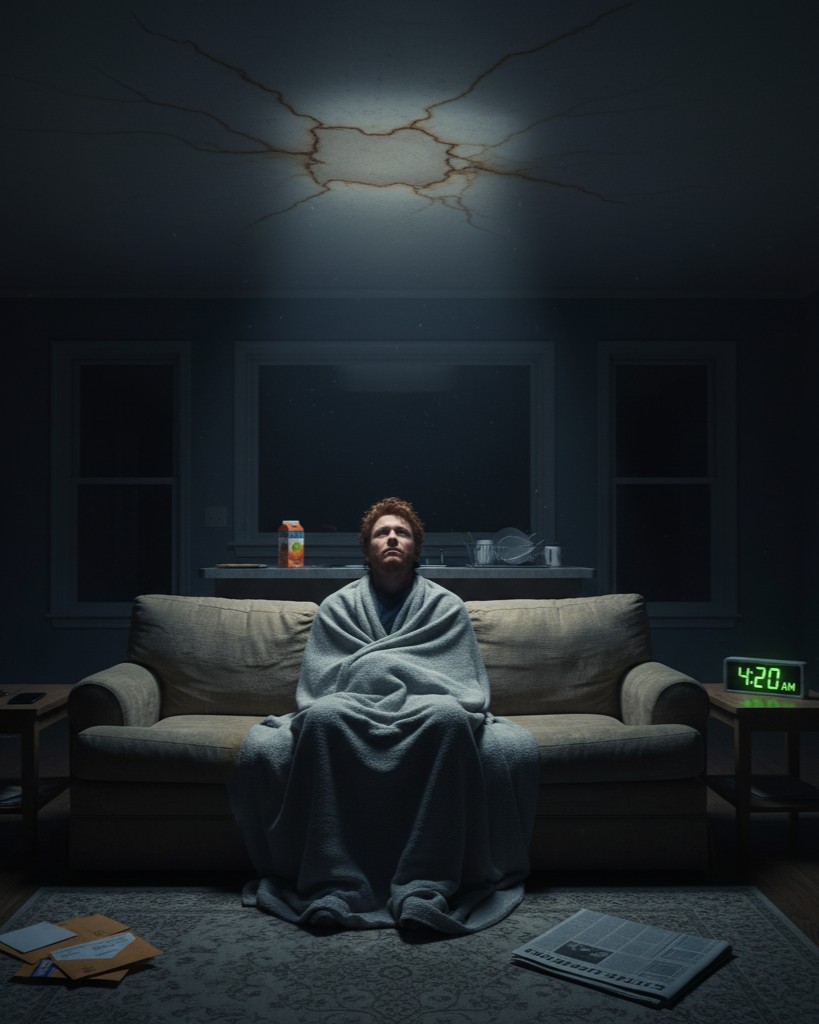
Don’s eyes opened. He knew the time without looking at the clock, just as he knew the couch cushion beneath him had a permanent dip shaped exactly like his body. It was four-twenty. The numbers on the clock across the room glowed in the dark, confirming he was right. He wasn’t asleep, and he wasn’t awake. He was just here, on the sofa again, waiting for a day he didn’t want to begin.
He stared up at the ceiling, finding the old water stain from the radiator leak on the second floor. It was a familiar shape, a faded brown-edged continent on a sea of white plaster. He had watched it for so many mornings now that it felt less like damage and more like a map, though a map to a place he never wanted to go. He pulled the thin, pilled fleece blanket tighter around his shoulders. The fabric didn’t offer much warmth, but it smelled like him, and the action of pulling it close was a physical comfort.
The thoughts came, as they always did in the morning silence. They didn’t pour in; they just appeared, fully formed and unwelcome. The gas bill, sitting on the kitchen counter under a pizza flyer, was now two weeks past due. The car, which he hadn’t moved from its spot at the curb since March, had been making a scraping sound from the front-right wheel. He knew, with a dull certainty, that the gas in the tank, still half-full after eight months, was probably going bad.
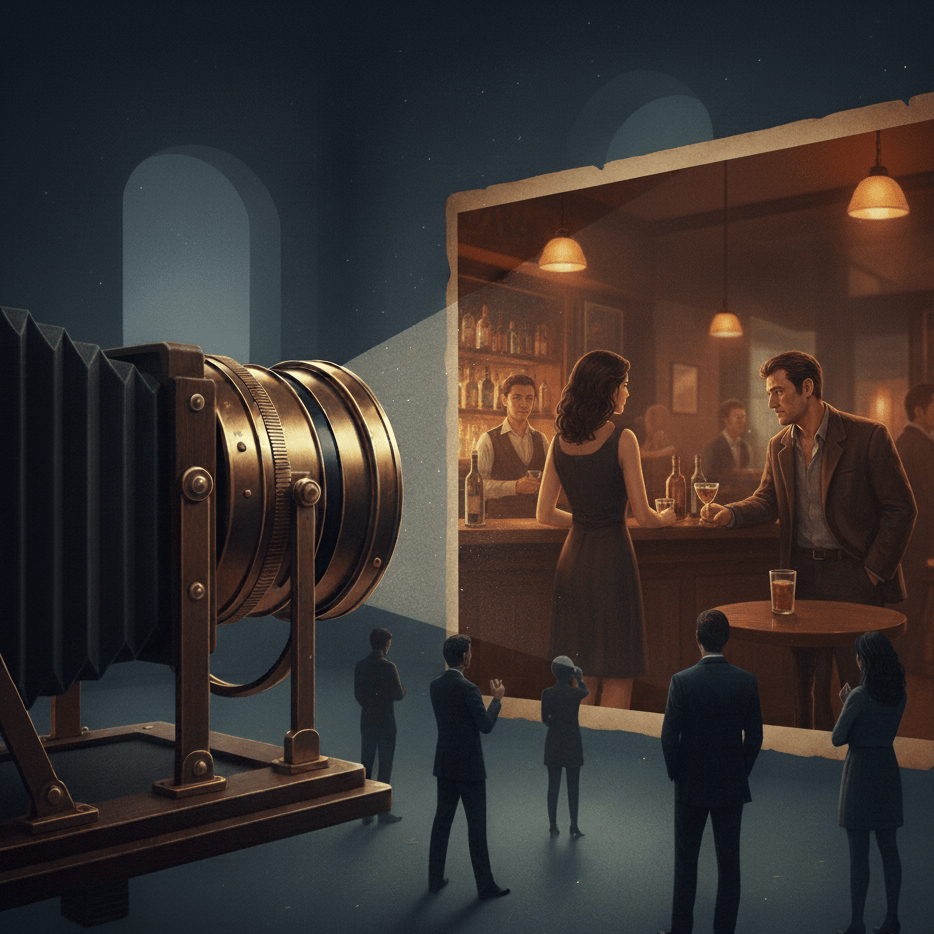
Then a different kind of thought slipped in, sharp and clear and unwelcome for an entirely different reason. It was a memory: he was standing in a room full of people with a glass in his hand. He was at a party, maybe two years ago, telling a story about a client. He could see the faces looking at him, could see Anne’s face, tilted up, laughing. He could hear his own voice, loud and confident, delivering the punchline. The sound of that collective laughter in his memory was so vivid it made the pre-dawn silence of his living room feel more absolute. The man in that memory, the one who gestured with his drink and held the attention of the room, felt like a complete stranger.
Don pressed the heels of his hands hard against his eye sockets. He held them there until the darkness behind his eyelids brightened with white flashes from the pressure. When he let his hands fall, the memory was gone, and he was just a man on a sofa in a dark room.
Eventually, he pushed the blanket off and swung his legs over the side. His bare feet met the floor, and he felt the immediate cold of the hardwood, followed by the thin, worn-out nap of the area rug. He stood on a spot right by the sofa that was so threadbare he could feel the rough backing of the rug against his feet. It was the patch of carpet he stood on every morning and every evening, a small, worn-down monument to his own wear.
He walked to the washroom, and he didn’t turn on the main light, which was too harsh; he reached instead for the small night-light over the medicine cupboard. He relieved himself and then stood at the sink, picking up his toothbrush. He watched his own reflection. His hair was pressed flat on one side from the sofa cushion. He had to use slow, calculated movements to brush his teeth, concentrating on the back-and-forth scrub. If he let his mind drift, if he didn’t focus on the simple mechanics of the action, his hand would begin to shake. The mint of the toothpaste tasted like chalk, and he spat into a sink that badly needed cleaning.
He went back into the living room, but he didn’t sit down. He walked toward the front door, stopping a good five feet away from it, well within the shadows of the room. He peeked through the window at the street. The sky was a lighter gray now, but still no light. He could just make out the shape of the newspaper, a white plastic-wrapped tube, lying at the end of his driveway, near the road. The paperboy always left it there, no matter how many times Don had, in his head, asked him to bring it closer. He thought about the walk. Across the living room, the click of the deadbolt, the squeak of the front door. Then the open air. The stretch of the concrete driveway. The visibility.
He saw a flicker of movement across the street. The curtains in Mrs. Gable’s window. She was an early riser. He could picture, with perfect, agonizing clarity, the sequence of events: he, in his old robe, would step outside, and the sudden motion would catch her eye. She would pull the curtain back fully, maybe step onto her own porch, and wave. She would shout, “Morning, Don! Haven’t seen you in a while!” Her voice was loud and cheerful, and he hated it. He would have to wave back, maybe shout a “hello,” and the whole interaction, the whole performance of being a normal human being, felt impossible. His stomach tightened into a cold knot. He stepped back from the window, retreating into the deeper shadows. The paper could stay where it was.
His stomach made a gurgling noise, and he realized he was hungry. The kitchen was cold. He flipped the light switch, and the weak bulb overhead tried to flicker on. A stack of mail sat by the phone, unopened. The top envelope, the one with the clear plastic window, was the gas bill. He ignored it and pulled the fridge door open. The rush of cold air felt good, but the smell didn’t. It was a mix of cold plastic and something just slightly off.
He looked at the contents. A half-gallon of one-percent milk, probably a week past its date. A wrinkled apple in the crisper drawer. A foil-wrapped plate of something he couldn’t identify. And a carton of orange juice, which he decided was the safer option. The sink was full of dirty glasses, so he just unscrewed the cap and drank straight from the carton. The liquid that hit his tongue wasn’t the sweet, cold rush he wanted. It was acidic and sharp, with a fermented tang. It had gone off. He made a face, a full-body wince, and pulled the carton away. He stared at it for a moment, as if it had personally betrayed him, then set it on the counter, not even bothering to put it in the sink.
He opened the fridge door again, staring at the empty shelves as if a new, better option might have materialized. He was hungry, and there was no food. This meant he had to go to the market. He pictured the market. The sliding glass doors that hissed open. The overwhelming brightness of the fluorescent lights that always seemed to hum at a frequency only he could hear. The clatter of metal shopping trolleys, the squeak of a bad wheel on the linoleum. The sheer number of people, all moving and talking. And then the checkout, the forced, friendly questions from the cashier. “Find everything okay?” “Got any plans for the weekend?” He thought about the simple act of forming a reply, of making his face look pleasant. He felt a wave of exhaustion so complete it was almost physical. He closed the fridge door.
He went back to the sofa. He just wasn’t hungry anymore. The hunger had been replaced by that hollow feeling in his stomach. He sat down in his spot, in the cushion’s dip. His car keys were on the end table, right where he’d left them in March, sitting on top of the mail he’d brought in that last day. He picked them up and remembered, for no reason at all, how he used to love driving, especially at night. He’d put on music, roll the windows down, and just go, enjoying the rush of the air and the blur of the lights. The car, with its half-tank of old gas and its scraping wheel, now felt less like a vehicle of freedom and more like a metal box he couldn’t bring himself to enter. He dropped the keys back on the table.
The sun was properly up now, and a harsh beam of light was cutting across the room, illuminating a billion swirling particles of dust. He watched them dance and spin. The house was starting to make its daytime noises. The creak of the plumbing as the heat kicked on. The electric hum of the refrigerator from the kitchen. Outside, far away, he heard the beep of the garbage truck starting its route, a sound that always made him tense, a reminder that the world was moving on, operating on a schedule he was no longer a part of.
He sat there for maybe an hour. He didn’t turn on the television. The noise, the fake cheerfulness, the endless cascade of bad news… it was all too much. Silence was better. The silence was at least honest.
Then, the phone rang, and the sudden, shrieking noise ripped through the house. Don jumped, a full-body flinch that sent a jolt of pain up his neck. His heart hammered against his ribs. He stared at the phone on the end table. The screen was lit up, vibrating violently against the wood. The name “SARAH” was bright and clear. His sister.
It rang a second time. He should answer it. He knew he should. Sarah was the only one who still called every few days. He should pick it up and say, “Hello.” But his throat felt thick, and he realized he hadn’t spoken a word, not one, in at least three days. His voice would be a dry croak. And then what? She would ask, “How are you, Don?” and her voice would be full of that careful concern. She would ask if he was eating, if he’d been outside, if he’d gotten the mail. He would have to lie, and the lies were exhausting. Or he would have to tell the truth, and the truth was unbearable.
It rang a third time. His hand actually moved, his fingers twitching, hovering an inch above the phone. Just pick it up. Just say hello. But he couldn’t. He couldn’t bridge the gap between his silence and her noise. He watched as his hand, the one that shook, fell back to his lap.
The phone rang a fourth time and then stopped. The silence that rushed back in was enormous, louder and more menacing than the ringing had been. He sat perfectly still, trying not to breathe. A few seconds later, the phone let out a short, quiet beep. A voicemail. The small red light on the base began to blink.
He didn’t move. He didn’t get the stale crackers from the pantry. He didn’t go back to the kitchen to throw out the sour juice. He just sat. The sunbeam moved across the floor, climbing the wall, and then it was gone as the afternoon clouds rolled in. The light in the room turned a flat gray. It got cold, but he didn’t get up to turn on the heat. He just pulled the thin blanket back over his legs, tucking it around his feet.
He sat there as the gray light faded and the room filled with darkness. Across the street, Mrs. Gable’s television flickered on, casting dancing flashes of light that he could see on his own ceiling. He watched them for a while. He wasn’t hungry. He wasn’t thirsty. He was just tired. He closed his eyes, not to sleep, but just to stop seeing. He would wait here, in the quiet, in the dip in the cushion, until the numbers on the clock told him it was time to wake again.




 Lia Declan's Musings
Leave a comment