
Choosing And Using Pen Names
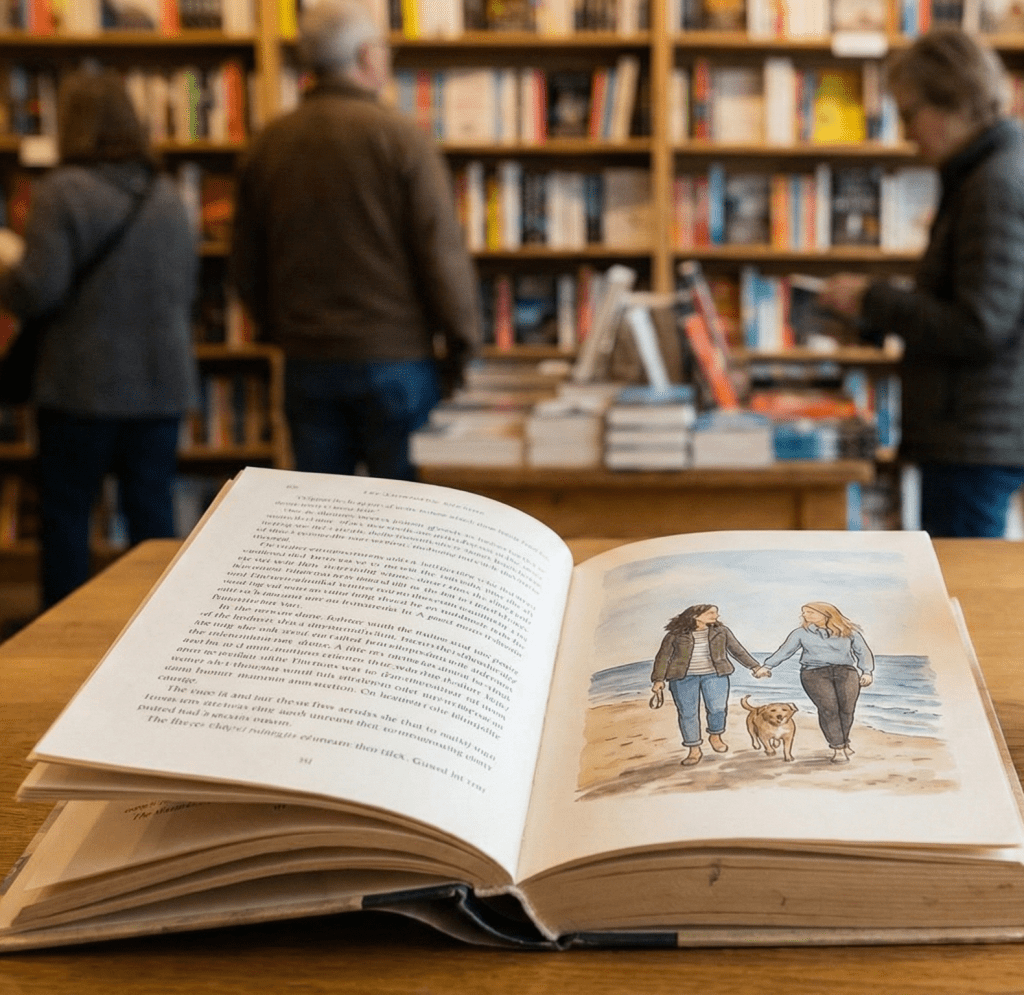
In my bookshop, there is one shelf that I walk past several times a day. It’s near the counter, within easy reach of the till. That shelf holds my own novels. Some of the spines read “Lia Declan.” Some of the spines read “Liam Declan.” Sometimes, customers notice.
Today, a woman stood in front of the shelf and read the names out loud. She turned to me and asked why I wrote as Lia sometimes and as Liam at others. Then she suggested that I should “just put both names on everything” so people would not get confused.
I did what many of us do in moments like that. I picked the answer that felt safe. I told her that I use Lia for my queer fiction and Liam for my more mainstream work. She accepted that. She gave a nod of understanding, bought a book, and left.
I stood at the counter and looked at that shelf. I saw the spines with both names, and I thought about how simple that explanation sounded compared to the long road that brought me to it. That moment is the reason I’m writing this.
This isn’t an abstract craft essay. This is one working writer talking about pen names. Why we use them. How we choose them. What they mean beyond marketing copy and author branding. I’ll start with the basic question.
What is a pen name, really?
A pen name is the name that appears on your book instead of, or alongside, the name on your legal documents. That’s the plain definition. In practice, a pen name can be a lot of different things at the same time.
It can be a safety measure, or it can be a privacy filter between your work and your day job. It can be a gender choice. It can be a way to mark different genres or different phases of your life.
It’s almost never “just” a gimmick.
When I publish as Lia, I’m not playing a character. I’m using the name that holds my queer work, my fluidity, and my decision to live more openly into the person I am now. When I publish as Liam, I’m not hiding from that. I’m drawing on another long stretch of my life and the expectations that came with it. I write different kinds of stories from each place. That division is real for me, and it isn’t “neat” or “cute” when someone asks me to collapse it for their convenience.
For many writers, a pen name grows out of a very simple need. The world around them isn’t safe enough yet for their legal name to sit under certain stories. That isn’t drama. That’s risk assessment.
Why we reach for a pen name:
When you think about using a pen name, you can start with three honest questions. I use these questions myself, and I offer them to other writers in my workshops.
First: What level of safety do you need?
Ask yourself what would happen if every person in your life could easily connect your legal name to this book. Would you lose work? Would you risk custody of your children? Would you face physical or verbal harassment? Would you lose housing or family support? If the answer is “possibly” or “I don’t know,” then a pen name becomes more than a stylistic choice. It becomes a barrier between your body and the worst case. It may not solve everything, but it’ll still help.
This is true for queer and trans writers. It’s also true for survivors who write about their own trauma. It’s true for whistleblowers. It’s true for anyone whose work might attract the attention of people who don’t play fair.
Second: What does your life look like outside the page?
Many writers hold jobs in schools, churches, government offices, or small towns where reputations travel faster than useful information. You may love your romance series, your horror novels, or your political essays. You may still need a degree of separation between those books and the name that appears on your professional badge.
A pen name can keep a parent from stumbling across your erotica when they search for your classroom blog. It can keep a parishioner from bringing your fantasy war crimes into the church foyer. It can give you room to write honestly without dragging every part of your life into direct collision.
Third: What does your name feel like in your own mouth?
This one is personal. When a festival host calls your name on stage, what do you want to hear? When you introduce yourself at a signing table, what name lets you stand up straight? If your legal name ties you to a gender that no longer fits, that name may not belong on the cover of the book that finally reflects who you are.
In my case, Lia is the name that fits when I write queer fiction that deals openly with gender, desire, and transition. It’s the name that belongs on those stories. It’s also the name on my apron in the shop. Liam sits on other work for reasons that are historical, practical, and sometimes contractual. The fact that both names sit on that one shelf in my shop isn’t evidence of confusion. It’s evidence of a life that has been lived in more than one little box.
Genre, audience, and the practical side:
Even if you feel safe using your legal name, you may still want a pen name for practical reasons. Readers use names as signals. Stores and libraries do the same.
If you write for children and you also write explicit adult material, separate names may protect both groups of readers. A parent shouldn’t have to sort through graphic horror to find your picture books. A teenager shouldn’t stumble into your most violent work by typing your name into a school computer.
If you write cosy mysteries and you also write bleak literary fiction, your audiences may carry very different expectations. You may not want your demonic seductress novel buried under reviews from readers who expected a light historical romance or a cat story. A second name can give each path its own direction.
This is where “branding” enters the conversation. It isn’t a dirty word. It simply means that people learn to associate a name with a certain kind of experience. You can do that with one name if your body of work holds together. You can also decide that you need two or three.
My own solution is straightforward on the surface. If a story is explicitly queer or leans into questions of gender and identity, I publish it as Lia. If a story is aimed at a broader or more “mainstream” audience, I look at whether it belongs under Liam. That line isn’t perfect. It has blurred edges. It still gives me a working structure.
How to choose a name:
Choosing a pen name can feel strange at first. You sit at a table with a notebook, and you try to write down possible versions of yourself. It can feel theatrical or “fake.” I want to say this clearly. You’re allowed to choose a name that you can grow into.
Some writers lift a name from family history. They use a grandmother’s surname or a middle name that was never spoken outside of home. Some create a name that has always sat in the back of their mind. Some look at their given names and make small changes that move the sound closer to their true emotional gender or culture.
If you want a checklist, you can ask:
- Can I spell it and pronounce it easily?
- Will readers in my main markets struggle with it?
- Is it already attached to a very famous author or actor?
- Does it have unpleasant associations in my own mind?
- Can I imagine signing it on hundreds of books?
You don’t need to find a perfect answer. You need to find a name that “feels right.” Over time, that name will gather your work and your history until it feels less like a costume and more like a well used tool.
What a pen name isn’t:
A pen name isn’t a promise of anonymity.
In the digital age, determined people can often connect pen names to legal identities. Public records, domain registrations, interviews, photographs from events, and loose talk can all link those strands. A pen name still provides a layer of difficulty. It’s better than nothing, but it’s not a magic cloak.
A pen name isn’t a lie about the content of your work.
If you write queer fiction under one name and straight romance under another, that division can make sense. However, if you present yourself as “own voice” under a name that implies a marginalised identity you don’t have, that becomes a separate ethical problem. Your name shouldn’t be used to claim experiences you haven’t lived.
A pen name isn’t a favour you owe to strangers.
When that customer suggested that I put both names on everything, she wanted my life to be easier for her to understand. She didn’t see the trade-offs. She didn’t see the years behind the choice. She thought she was offering a neat solution. I stood there and felt the sincerity of what she asked. She wanted me to collapse two histories into one line so that her mind could comprehend the meaning without straining itself.
You’ll meet many people like that. They’ll say, “So which one is your real name?” They’ll press for details. They’ll treat your identity as a puzzle they deserve to solve. You don’t have to satisfy that urge.
How to talk about it:
You can prepare a few standard answers and keep them handy.
For casual situations, I often say, “I use different names for different genres. It helps readers find what they want.” That sentence is true and boring. It closes most conversations.
If I feel comfortable, I might add, “Lia is my name, and I use it for my queer work.” Sometimes I add that safety played a part when I first made that decision. Sometimes I don’t. Not so much anymore.
For close friends or for essays like this, I can say more. I can talk about gender. I can talk about the way old names cling to documents and how long it takes to change them. I can talk about the fear around outing, the relief of seeing the right name on a cover, and the ache that comes with the wrong one.
You can decide where your own lines sit. The important thing is that you make that decision on purpose, not in panic, in the moment when someone corners you at a table. I don’t see my given name in print and cringe; I see it as another side of myself that belongs to a different world.
What it means to see your names on a shelf:
I come back to that shelf in my shop. On one side, titles sit under Liam. On the other side, several sit under Lia. Customers stand in front of that shelf and tilt their heads, and ask questions. Some ask with genuine interest. Some ask with entitlement. Some don’t ask at all and simply pick up a book.
For me, that shelf isn’t a problem to solve. It’s a record of my life as a writer and as a person. It shows the years when I wrote under one name because I saw no other option. It shows the years when I claimed another name in full view. Both sets of books exist. Both sets matter.
If you choose to use a pen name, or several, you’ll eventually have your own version of that shelf. It might be a digital storefront or a section of a library catalogue rather than a physical bookcase in a physical bookshop. You may see several names stacked there. When you do, I hope you remember this.
A pen name isn’t only a marketing device. It’s a tool that lets you shape how your work affects your life. It can protect you. It can give you space. It can mark growth. It can keep different communities from colliding in ways that would hurt you or your readers. It deserves thought. It deserves respect.
Most of all, it belongs to you.
Your name on the cover isn’t a public property that strangers get to rearrange. It’s a choice you make in full view of your own history. Whether you choose one name or several, whether you stand in a shop with your own shelf or send your books into the world from a kitchen table, that choice is yours to keep. And it matters.


 Lia Declan's Musings
Leave a comment