
Why Movement Matters More Than Method
I can already see some of you raising your eyebrows, waiting for me to reveal some secret routine. The truth is, I don’t have one. My process is a jumbled mess. Some days, I spend hours drafting an outline that I don’t follow. Some days, I toss the outline entirely and start writing in the middle of a scene that’s only half-formed in my mind. Other times, I have no idea how the story will begin, but I write the final scenes before I have even spoken to my characters. Some days, I move from my desk to the sofa to the deck and back again without producing a single sentence that makes it into the final draft. That’s what I mean when I say “if you can call it that.”
The obsession with “process” is, in my opinion, overblown. Everyone wants to know the routine of a professional writer, as if copying my habits will magically make you productive. It won’t. In fact, copying my habits might just make you rethink your vocation choices. What works for one writer won’t necessarily work for another. Some writers need silence, some need music. Some need daylight, some write best at 2 a.m. Chaos is not necessarily a bad thing.
Starting Somewhere
The first thing you need to know is that I start somewhere. Sometimes it’s an outline, sometimes it’s a single sentence, sometimes it’s a fragment of dialogue. The outline is a starting point, not a law. I often spend days creating it, only to abandon it as soon as a scene starts to evolve. The story can, and will, diverge from it. Accept that, embrace it. Your process cannot be fixed; it has to evolve as your characters evolve. Let them dictate the story.
If you are one of the lucky ones who has a fully developed idea, concept, or outline pop into your head, then I envy you. Many times I will sit alone, scrolling social media, looking for something that sparks an idea. I will sit with my girlfriend and ask, even beg, her for ideas. Other times, I’ll be standing on queue in the market, or walking around the shop, shelving new arrivals, or sleeping peacefully, minding my own business, when an idea intrudes into my brain and I have no choice but to tend to it immediately.
Let It Be Bad
One of the things you’ll notice if you look at my drafts is that they are messy. Spelling mistakes, punctuation errors, repeated words, incomplete sentences, and huge chunks of unpolished text are everywhere. I write like that intentionally. Drafting is about discovery, and if I stop to polish every line, I lose the thread of the story, the rhythm of the character, the momentum that carries me forward.
You cannot edit an evolving story, you can only discover it, one messy sentence at a time. I have a folder on my hard drive that is filled with first drafts in varying stages of incompletion, because I got a few chapters into an idea and lost interest. I may go back to them someday, or I may not. If the characters call out again, I’ll be there to answer.
Many writers fall into the trap of revising as they go. You write a sentence, then change it. You correct the punctuation, swap the adjective, reorder clauses. That is poison at the first draft stage. It is almost never useful. It dehumanizes the prose. You are not listening to the story; you are listening to your inner critic. You are converting your voice into a sterile imitation of literature. Leave it alone. Let it be bad. Let it be human. You will fix it later, once the story exists in full.
In Chosen by Winter, I wrote a single paragraph that ran over a thousand words. It was unbroken, full of repetitions, half-formed ideas, and punctuation errors. But it captured the rhythm of thought. It captured the way the narrator actually thinks. Had I stopped to clean it, it would have lost everything that made it alive. That mess, the contradictions, the stumbles, the irregularities, is the human element. It is why the story works. Not because it was tidy, but because it existed first, alive, messy, flawed. That novel, by the way, which I thought I would never finish, turned out to be over a thousand pages at third edit and got split into a trilogy.
Contrast that with The Unbroken Bond. There, I tried to be careful from the first line. I polished as I wrote. The prose became flat. I had eliminated the stumbles, the hesitations, the things that made the narrator human. By the time I realized what was happening, I had to undo and rewrite days of work. I was polishing a skeleton, not a living story.
Stagnation on the Page
Stagnation in one place leads to stagnation on the page.
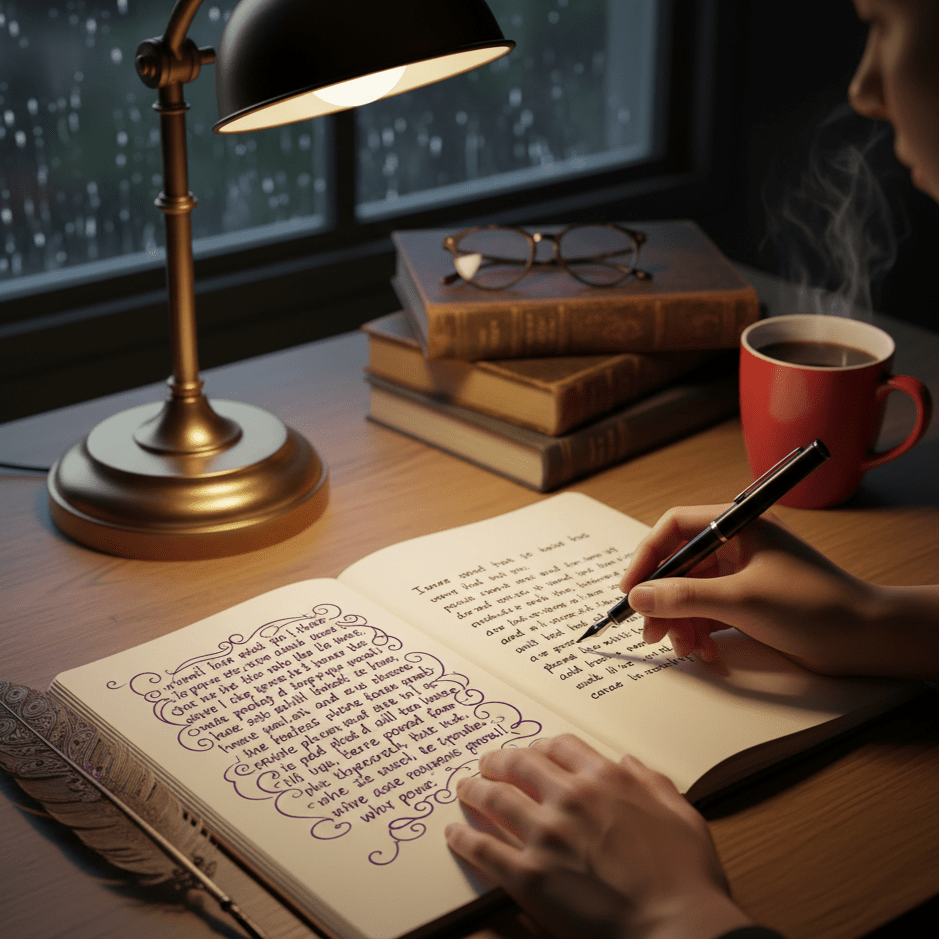
I change my location and tools constantly. I have a desk, a comfortable chair, a laptop, an antique wingback, a barstool, and even the sofa. I frequently sit with my laptop, in the dark, on the edge of my bed, in the middle of the night. I write in notebooks, on scraps of paper, and sometimes dictate into my phone.
The point isn’t comfort or aesthetics, it’s movement. I need to shift my body and my attention. A different chair, a different table, even a different room can kick-start the mind. I can’t count the number of times that a customer has said something that sparks an idea, and I whip out my phone, standing behind the till.
Writing is not only mental. It’s movement, coordination, repetition. Standing, walking, typing with different hands, writing on different surfaces; all of these help trigger the mental act. Sitting in the same chair too long will make the words stop. You will not “push through.” You will only hate the chair and your story. Change it. Shift context. Force motion.
The human brain is complicated, and some, like mine, are a series of rooms. Some are empty, and others are cluttered and dangerous to walk in. Writing is work. You are generating ideas, constructing sentences, evaluating logic, tracking continuity, and making thousands of small decisions at once. When the work stops, it is rarely because some mystical “block” has descended. If you sit and wait for inspiration, you are waiting for a signal that might never come.
You cannot write in a vacuum. Ideas, observations, raw material are necessary. Reading, listening, watching, touching, walking, observing. If the brain is empty, it cannot produce. Often what looks like writer’s block is a signal that you need more fuel. Go gather it. Take notes. Take photos. Collect phrases. Fill your mind so your hands can work.
A messy process, a jumbled approach, a constantly changing location, and sporadic output… all of this works if you keep showing up. Curiosity and persistence are the foundation. Everything else, location, tools, outline, time of day, all can vary. The point is to create conditions that allow you to return to the page repeatedly.
Whatever your process looks like, as long as it allows you to return to the page and keep producing, it is valid. The process is not about making writing easier. It is about making writing possible. That’s all you need, everything else is decoration.
Conclusion
So, if you take one thing from this, let it be simple: your process does not have to be perfect. Your routine will be messy, your outlines will go ignored, your drafts will be riddled with errors. That isn’t failure, it’s the work of a writer. The job is not to wait for inspiration, to polish every line, or to make the process look elegant. The job is to show up. To put words on the page. To move forward, even when it feels awkward or chaotic.
Write badly. Write fragments in the middle. Write for ten minutes, for two hours, for a single paragraph. Whatever gets you moving counts. The human part of your writing, the voice, the rhythm, the mistakes, is what gives it life.
Keep showing up. Keep moving. Keep the words alive. The rest, the polish, the perfection, will follow when the story exists.
Am I the only one who works this way? Please, tell me about your process.





 Lia Declan's Musings
Leave a comment